 2026, Vol. 25


肾盂输尿管连接部梗阻(ureteropelvic junction obstruction, UPJO)是产前及新生儿肾积水的最常见原因[1]。胎检发现肾盂积水的胎儿出生后,5% ~20% 被确诊为UPJO,其发病率约为1/1 500活产婴儿[2-3]。腹腔镜离断式肾盂成形术治疗儿童UPJO,具有与开放手术相当的早期临床疗效和安全性,且具备创伤小、恢复快、美容效果好等优势[4]。尽管机器人辅助腹腔镜手术已广泛开展且被证实有效、安全,但受成本限制,腹腔镜手术在部分医疗中心仍是治疗儿童UPJO的主要术式[5]。发热是外科术后常见并发症,发病率为10% ~40%[6]。儿童体温调节中枢尚未完善,术后发热发生率更高,相关文献报道为30.6% ~84.4%[7-8]。术后发热常提示泌尿系感染,不仅影响手术效果,还会引发家属焦虑,尤其是高热(≥39℃)可能导致婴幼儿高热惊厥,甚至危及生命,严重影响患儿术后恢复及身体健康[8]。因此本研究针对儿童腹腔镜肾盂成形术(laparoscopic pyeloplasty,LP)后发热的特点及影响因素进行分析,旨在为术后发热的预防和干预提供临床依据。
资料与方法 一、研究对象本研究为病例对照研究,回顾性收集2018年6月至2023年8月兰州大学第二医院泌尿外科同一手术团队治疗的先天性肾盂积水伴UPJO患儿临床资料。病例纳入标准:①术前确诊先天性UPJO;②无其他泌尿系畸形;③年龄≤12岁;④首次行单侧LP且术中放置输尿管支架管。排除标准:①输尿管支架植入失败;②中转开放手术;③术前存在其他部位感染、症状性泌尿系感染及尿培养阳性;④术前接受过其他外科干预;⑤术后出现其他部位感染。最终纳入143例,其中男性122例、女性21例;左侧106例、右侧37例;术前均经B超、MRU等检查明确诊断。本研究经兰州大学第二医院伦理委员会审批通过(2026A — 055)。
二、研究方法及内容手术严格遵循最新指南,采用经腹腔途径腹腔镜下离断式肾盂成形术[9]。体温测量采用腋窝水银温度计:体温正常患儿每4 h测量1次,术后3天体温仍正常则改为每6~8 h测量1次;发热患儿每2~3 h测量1次,高热患儿每1小时测量1次。尿标本为晨起第一次清洁中段尿。
定义标准:术前尿常规正常指尿细菌、白细胞(定性及定量结果)均在正常参考值范围,且亚硝酸盐阴性;术前无症状尿常规异常指无尿路刺激症状、发热、喂养困难、生长发育迟缓等尿路感染相关症状,但尿常规显微镜下可见细菌和/或尿沉渣中白细胞>5个/高倍视野(排除亚硝酸盐阳性患儿,本研究纳入患儿无此类合并情况)。DPF指术后体温>37.3℃至体温≤37.3℃且不再上升的持续时间。
围术期抗菌治疗方案:术前30 min静脉给予头孢类抗菌素1次;术后无发热或发热 < 38.5℃者,仅予物理降温,不再使用抗菌素;术后发热≥38.5℃者,静脉给予二、三代头孢菌素,同时联合物理降温及口服布洛芬等降温药物,直至体温恢复正常且无反复[10]。
收集患儿临床资料:术后发热持续时间(duration of postoperative fever,DPF)、术后最高体温(highest postoperative body temperature, HPBT)、术后高热(postoperative high fever, PHF)发生情况,以及年龄、性别、手术侧别、术前尿常规异常(abnormity of urine routine, AUR)、术前肾盂前后径(anteroposterior diameter, APD)、术中支架管型号、手术持续时间、术中出血量、术后漏尿情况及体重。
三、统计学处理采用SPSS 26.0进行统计学分析。计量资料(年龄、APD、手术持续时间、出血量、体重)均为非正态分布,采用M(Q1,Q3)描述,组间比较采用秩和检验(Mann-Whitney U检验或Kruskal-Wallis H检验),相关性分析采用Spearman相关。PHF分类变量采用频数、构成比描述,组间比较采用χ2检验。采用二元Logistic回归进行影响因素的多因素分析。P < 0.05为差异有统计学意义。
结果143例中,年龄与DPF呈负相关(r=-0.307,P < 0.01);DPF与HPBT呈正相关(r=0.717,P < 0.01);DPF、HPBT与APD、手术持续时间、术中出血量、体重均无相关性;年龄与HPBT无相关性。
143例中,漏尿信息缺失1例、支架管型号信息缺失1例,故相关变量分析纳入142例。其中术后无漏尿119例、漏尿23例;术前尿常规正常111例、AUR 32例;术中置入F3支架管82例、F4支架管34例、F4.7支架管26例。
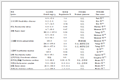
DPF在性别(P=0.486)、手术侧别(P=0.190)、术后漏尿(P=0.112)中的差异无统计学意义,在术前AUR(P < 0.001)、支架管型号(P=0.003)中的差异有统计学意义;HPBT在性别(P=0.977)、手术侧别(P=0.910)中的差异无统计学意义,在术后漏尿(P=0.040)、术前AUR(P < 0.001)、支架管型号(P=0.010)中的差异有统计学意义,但术后漏尿对HPBT的影响无明显临床意义(漏尿组中位HPBT 38.0℃,无漏尿组38.3℃)。术前AUR患儿的DPF更长、HPBT更高;支架管型号总体对DPF、HPBT有影响。支架管型号两两比较结果:DPF方面,F3型号与F4、F4.7型号差异有统计学意义(P=0.020、P=0.018),F4与F4.7型号差异无统计学意义(P=1.000);HPBT方面,F3与F4.7型号差异有统计学意义(P=0.043),F4与F3、F4.7型号差异无统计学意义(P=0.052、P=1.000)。见表 1。
| 表 1 不同亚组间UPJO患儿的术后发热持续时间与术后最高体温 Table 1 Duration of postoperative fever and highest postoperative body temperature in UPJO children across different subgroups |
|
143例中,术后高热组22例、术后无高热组121例。PHF在年龄、手术时间、术中出血量、体重、术前APD、性别、手术侧别、术后漏尿、支架管型号中的差异无统计学意义(P>0.05),在术前AUR中的差异有统计学意义(P=0.011);见表 2。二元Logistic回归分析结果显示,术前AUR是术后高热的独立危险因素(OR=3.750,95%CI:1.439~9.774,P=0.007)。
| 表 2 UPJO患儿术后高热的影响因素分析结果 Table 2 Analysis of influencing factors for postoperative high fever in UPJO children |
|
|
术后发热分为非感染性和感染性因素,多数发热是机体对组织损伤的生理反应,由炎症因子释放介导[11-13]。泌尿系感染是儿童常见感染性疾病,也是抗菌素治疗的主要疾病之一,而UPJO是儿童泌尿系感染的危险因素[14-15]。发热及发热性尿路感染是儿童肾盂成形术后常见并发症[16]。本研究143例患儿中,术后发热(>37.3℃)122例,无发热21例,与相关文献报道的术后发热发生率相符[8]。本研究发现,年龄与DPF呈负相关,与Kinoshita等[7]研究神经内窥镜术后发热影响因素的结论一致,推测原因可能是低龄儿童体温调节中枢更不完善,易受组织损伤、感染及炎症因子等因素影响。同时,DPF与HPBT呈正相关,提示儿童LP术后发热体温越高,持续时间越长,这是术后发热的重要特点。此外,性别、手术侧别对DPF、HPBT均无明显影响,关于手术侧别对术后发热性感染无影响的研究结论一致,而性别对术后发热性感染的影响尚无统一结论。
术后漏尿是本研究中除发热外最常见的并发症,本研究定义术后引流液>50 mL为漏尿。本研究显示,漏尿对DPF无明显影响,对HPBT的影响虽有统计学意义,但无明显临床意义,可能与样本量较少导致的偏倚有关。术后高热对患儿影响更为显著,本研究证实术前AUR是术后高热的独立危险因素,且术前AUR患儿的DPF更长、HPBT更高。目前相关临床指南未对无症状AUR患儿LP术前抗菌治疗作出详尽规定,本研究中此类患儿仅接受短程预防性抗菌治疗,但术后发热相关指标均显著较差,提示可能需要延长术前抗菌治疗疗程,复查尿常规正常后再行手术,这一结论需进一步病例对照研究验证[10]。
支架管型号对术后发热的影响结论不一:本研究显示F4、F4.7型号支架管术后发热相关指标(DPF、HPBT)优于F3型号,推测可能与较粗管径支架管的尿液引流效果更好、管腔不易堵塞有关;但也有荟萃分析提出,小管径支架管术后尿路刺激、腰腹部不适感更轻,且对术后发热无明显影响[17]。因此,支架管型号选择需结合患儿具体情况及术者临床经验综合判断。但本研究为回顾性研究,虽严格制定纳入及排除标准以控制混杂因素,但术后发热的干预措施及其他潜在混杂因素仍可能对结果产生影响,需进一步开展同质化研究及临床实践验证结论。
利益冲突 所有作者声明不存在利益冲突
作者贡献声明 符小宝负责研究的设计、实施和起草文章;符小宝、徐娜娜、李笑然、米军、王培龙进行病例数据收集及分析;符小宝、杨宁强负责研究设计与酝酿,并对文章知识性内容进行审阅
| [1] |
Dias CS, Silva JMP, Pereira AK, et al. Diagnostic accuracy of renal pelvic dilatation for detecting surgically managed ureteropelvic junction obstruction[J]. J Urol, 2013, 190(2): 661-666. DOI:10.1016/j.juro.2013.02.014 |
| [2] |
Ismaili K, Avni FE, Wissing KM, et al. Long-term clinical outcome of infants with mild and moderate fetal pyelectasis: validation of neonatal ultrasound as a screening tool to detect significant nephrouropathies[J]. J Pediatr, 2004, 144(6): 759-765. DOI:10.1016/j.jpeds.2004.02.035 |
| [3] |
Kari JA, Roebuck DJ, Tullus K. Renal artery stenosis in association with congenital anomalies of the kidney and urinary tract[J]. Saudi Med J, 2014, 35(10): 1264-1266. |
| [4] |
Chen JC, Zhang QL, Wang YJ, et al. Laparoscopic disconnected pyeloplasty to treat ureteropelvic junction obstruction (UPJO) in children[J]. Med Sci Monit, 2019, 25: 9131-9137. DOI:10.12659/MSM.918164 |
| [5] |
Sun L, Zhao DY, Shen YD, et al. Laparoscopic versus robot-assisted pyeloplasty in infants and young children[J]. Asian J Surg, 2023, 46(2): 868-873. DOI:10.1016/j.asjsur.2022.09.046 |
| [6] |
Lesperance R, Lehman R, Lesperance K, et al. Early postoperative fever and the"routine"fever work-up: results of a prospective study[J]. J Surg Res, 2011, 171(1): 245-250. DOI:10.1016/j.jss.2010.03.009 |
| [7] |
Kinoshita Y, Tominaga A, Saitoh T, et al. Postoperative fever specific to neuroendoscopic procedures[J]. Neurosurg Rev, 2014, 37(1): 99-104. DOI:10.1007/s10143-013-0505-7 |
| [8] |
Corkum KS, Hunter CJ, Grabowski JE, et al. Early postoperative fever workup in children: utilization and utility[J]. J Pediatr Surg, 2018, 53(7): 1295-1300. DOI:10.1016/j.jpedsurg.2017.06.019 |
| [9] |
黄健, 张旭, 魏强, 等. 中国泌尿外科和男科疾病诊断治疗指南: 2022版[M]. 北京: 科学出版社, 2022: 934-936. Huang J, Zhang X, Wei Q, et al. Chinese Guidelines of Diagnosing and Treating Urologic and Andrologic Diseases (Edition 2022)[M]. Beijing: Science Press, 2022: 934-936. |
| [10] |
Nicolle LE, Gupta K, Bradley SF, et al. Clinical practice guideline for the management of asymptomatic bacteriuria: 2019 update by the Infectious Diseases Society of America[J]. Clin Infect Dis, 2019, 68(10): e83-e110. DOI:10.1093/cid/ciy1121 |
| [11] |
马明信, 杨昭徐, 程毓蒨, 等. 诊断学[M]. 北京: 北京大学医学出版社, 2010: 7. Ma MX, Yang ZX, Cheng YQ, et al. Diagnostics[M]. Beijing: Peking University Medical Press, 2010: 7. |
| [12] |
Andres BM, Taub DD, Gurkan I, et al. Postoperative fever after total knee arthroplasty: the role of cytokines[J]. Clin Orthop Relat Res, 2003, 415: 221-231. DOI:10.1097/01.blo.0000093914.26658.55 |
| [13] |
Christabel A, Sharma R, Manikandhan R, et al. Fever after maxillofacial surgery: a critical review[J]. J Maxillofac Oral Surg, 2015, 14(2): 154-161. DOI:10.1007/s12663-013-0611-7 |
| [14] |
Spencer JD, Schwaderer A, McHugh K, et al. Pediatric urinary tract infections: an analysis of hospitalizations, charges, and costs in the USA[J]. Pediatr Nephrol, 2010, 25(12): 2469-2475. DOI:10.1007/s00467-010-1625-8 |
| [15] |
Freedman AL, Urologic Diseases in America Project. Urologic diseases in north America project: trends in resource utilization for urinary tract infections in children[J]. J Urol, 2005, 173(3): 949-954. DOI:10.1097/01.ju.0000152092.03931.9a |
| [16] |
Nerli RB, Reddy M, Prabha V, et al. Complications of laparoscopic pyeloplasty in children[J]. Pediatr Surg Int, 2009, 25(4): 343-347. DOI:10.1007/s00383-009-2341-y |
| [17] |
Wu G, Sun FZ, Sun K, et al. Impact of differential ureteral stent diameters on clinical outcomes after ureteroscopy intracorporeal lithotripsy: a systematic review and meta-analysis[J]. Int J Urol, 2021, 28(10): 992-999. DOI:10.1111/iju.14631 |