 2026, Vol. 25


2. 青岛大学附属医院妇科, 青岛 266003;
3. 青岛大学附属医院手术室, 青岛 266003;
4. 山东省数字医学与计算机辅助手术重点实验室, 青岛 266003
2. Department of Gynecology, Affiliated Hospital, Qingdao University, Qingdao 266003, China;
3. Operating Room, Affiliated Hospital, Qingdao University, Qingdao 266003, China;
4. Shandong Provincial Key Laboratory of Digital Medicine & Computer-Assisted Surgery, Qingdao 266003, China
肝母细胞瘤(hepatoblastoma, HB)是儿童期常见肝脏恶性肿瘤,约占儿童肝脏恶性肿瘤的80%,治疗方案的选择高度依赖肿瘤体积与分期,手术切除是重要治疗手段[1-2]。肿瘤体积占肝脏总体积的比例可直接影响手术的可行性、手术时机、切除后残余肝脏体积以及术后恢复。对于部分无法直接手术的患儿,往往采取术前化疗[3-4]。传统的治疗前疾病范围分期(pretreatment extent of disease, PRETEXT) 系统虽被广泛应用,但对体积的量化评估不足,导致部分患儿化疗过度或化疗不足[5]。本研究通过海信计算机辅助手术系统(Hisense computer-assisted system, Hisense CAS)获取精准的肿瘤与正常肝脏体积数据,以肿瘤体积占比50%为界进行分层,提出基于肿瘤体积占比的分层与治疗方法,为不同肿瘤体积占比患儿制定精准治疗方案提供参考[6]。
资料与方法 一、一般资料本研究为回顾性队例研究,回顾性收集2014年1月至2024年12月青岛大学附属医院收治的59例HB患儿临床资料。病例纳入标准:①经病理穿刺活检或术后病理检查诊断为肝母细胞瘤;②在本研究机构接受直接手术治疗或新辅助化疗后手术治疗。排除标准:①临床资料缺失;②不符合分组标准(如肿瘤侵犯重要血管无法直接手术);③因肿瘤破裂等原因接受急诊手术。本研究已通过青岛大学附属医院伦理委员会审核批准(QYFYWZLL30121),患儿监护人均知情并签署知情同意书。
59例中,27例采取直接手术治疗,32例采取新辅助化疗后手术治疗。根据治疗前肿瘤体积占比[肿瘤体积/(正常肝脏体积+肿瘤体积)×100%]进行分组,肿瘤体积占比<50%为小体积占比组(n=27),其内又分为两个亚组,术前接受化疗者为小体积占比化疗组(n=10),直接手术治疗者为小体积占比手术组(n=17);肿瘤体积占比≥50%为大体积占比组(n=32),其内又分为两个亚组,术前接受化疗者为大体积占比化疗组(n=22),直接手术治疗者为大体积占比手术组(n=10)。
本研究选取肿瘤体积占比50%为分界点,原因在于:对所有患儿肿瘤体积占比与初诊治疗方式进行受试者操作特征(receiver operator characteristic, ROC)曲线分析,结果显示曲线下面积(area under the curve, AUC)为0.725(P < 0.001),约登指数最大时对应最佳截断值为49.2%,与本研究采用的肿瘤体积占比50%高度接近,从统计学角度为确立该分界点提供了支撑。
二、影像学检查上腹部CT增强扫描仪为美国GE64层螺旋CT。海信计算机辅助手术系统(Hisense computer-assisted system,Hisense CAS)为青岛大学附属医院与青岛海信集团联合研发的完全国产化、自主研发智能医学影像处理软件系统。
检查前禁食4~6 h,静脉注入碘海醇造影剂,扫描范围从肝脏上方的横膈膜到胰腺下缘,扫描结束后将图像上传至工作站以DICOM格式储存。
Hisense CAS接收到输入的增强CT影像后,将识别到的二维CT影像信息变成三维立体影像。重建后的三维立体影像与二维CT影像对比,可多角度、全方位旋转观察三维重建模型[7]。
三、治疗方案均采取开腹手术。根据肿瘤所处肝叶位置行腹部肋缘下斜切口或人字形切口,切断与肿瘤临近的韧带,行区域性血流阻断,沿肿瘤边缘约1 cm,切除肿瘤及部分肝组织,创面放置引流管,逐层缝合腹壁各层[8-9]。
采取术前化疗者均于术前予2~6个疗程的新辅助化疗。遵循目前公认的化疗方案。①低危组:为C5V方案(顺铂+5-氟脲嘧啶+长春新碱),连续21天为1个疗程,完成4~6个疗程后手术。②中危组:为C5VD方案(顺铂+5-氟脲嘧啶+长春新碱+阿霉素),连续21天为1个疗程,完成2~4个疗程后手术。③高危组:顺铂+阿霉素,连续21天为1个疗程,完成3个疗程后评估,对可手术切除者采取手术方案[3, 10]。
四、评估指标及相关定义收集所有患儿年龄、性别、甲胎蛋白(alpha fetoprotein,AFP)水平、组织学分型、出血量、肝功能检验结果、术后恢复时间、剩余肝占比等[11-12]。①AFP:取实施初诊治疗方案前最近一次检验结果。②出血量:完成手术全过程的出血量。③肝功能检验恢复正常时间:指术后肝功能检验指标(谷丙转氨酶、谷草转氨酶、总胆红素)恢复正常的时间。④剩余肝占比:指术后剩余肝脏体积占初诊治疗前正常肝脏体积的比例。
五、统计学处理采用SPSS 27.0进行统计学分析,对于连续型变量首先进行Shapiro-Wilk正态性检验,服从正态分布的计量资料以x±s表示,组间比较采用两独立样本t检验。非正态分布的计量资料以M(Q1, Q3) 表示,组间比较采用Mann-Whitney U检验。计数资料以例(%)表示,因各组样本量不足40,因此组间比较使用Fisher确切概率法。P<0.05为差异具有统计学意义。
结果本研究59例患儿均由同一名高年资医师主刀完成手术,无一例接受二次手术。两组及其亚组患儿基线特征见表 1、表 2。59例患儿初始肿瘤体积占比及其与临床指标的相关性见表 3。小体积占比组内两亚组患儿诊断时年龄、性别组成、血清AFP水平及组织病理学分型差异均无统计学意义(P>0.05)。大体积占比组内两亚组患儿诊断时年龄、性别组成、血清AFP水平及组织病理学分型差异亦无统计学意义(P>0.05)。小体积占比组与大体积占比组比较,PRETEXT分期及化疗疗程数差异无统计学意义(P>0.05),只在治疗方案的选择上具有统计学意义(P=0.02)。
| 表 1 小体积占比组肝母细胞瘤患儿基线特征 Table 1 Baseline profiles of small volume proportion group |
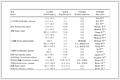
|
| 表 2 大体积占比组肝母细胞瘤患儿基线特征 Table 2 Baseline characteristics of children in large volume proportion group |
|
|
| 表 3 不同体积占比肝母细胞瘤患儿初始肿瘤体积占比及与临床指标的相关性 Table 3 Initial tumor volume proportion and its correlation with clinical indicators |
|
|
59例患儿术后短期内均未出现并发症等情况。小体积占比组两亚组出血量差异具有统计学意义(P=0.014),手术组出血量较少,肝功能恢复正常时间(P=0.388)及剩余肝比例(P=0.396)差异均无统计学意义。大体积占比组两亚组在肝功能恢复正常时间(P=0.037)及剩余肝比例(P=0.004)方面差异具有统计学意义,化疗组均占优势;而出血量差异无统计学意义(P=0.194)。见表 4、表 5。
| 表 4 小体积占比组肝母细胞瘤患儿手术情况[M(Q1,Q3))] Table 4 Assessment of surgical outcomes in children with small volume proportion groups[M(Q1, Q3))] |
|
|
| 表 5 大体积占比组肝母细胞瘤患儿手术情况[M(Q1,Q3))] Table 5 Assessment of surgical outcomes in large volume proportion groups[M(Q1, Q3))] |
|
|
手术是根治HB的重要方式。根据最新儿童肝母细胞瘤诊疗规范,HB直接手术的指征较为严格,满足该指征的患儿较少,因此对于指征以外的患儿尤其是小体积肿瘤患儿是否可以直接手术临床仍存在争议,其中肿瘤体积占比是重要考量因素[13]。而对于大体积肿瘤,部分患儿符合上述直接手术指征,但直接手术也会减少大量正常肝组织,且直接手术对术者技术要求极高,虽然术中超声及荧光显像技术的应用可减少误切,但技术普及率尚不高[14]。目前,对于不符合直接手术指征的患儿,主流治疗方案为先行术前辅助化疗,化疗方案主要综合国际儿童肝肿瘤协作组肝脏肿瘤分期系统(Strategy Group for International Oncology Pediatric Epithelial Liver Tumours, SIOPEL)及COG的危险度分层标准,按照极低危、低危、中危和高危分层选择不同化疗方案[8]。可否直接手术或化疗是否存在不足或过度尚无法准确评估[3]。
本研究发现,在大体积占比组内,化疗组较手术组术后剩余肝比例较高,且术后肝功能恢复更快。可能原因为:化疗后肿瘤体积缩小,其与正常肝组织的接触面积会减少,在手术中损失的正常肝组织也会减少,剩余肝脏比例会增加;而且,由于正常肝组织的保留会使得肝代谢能力增强,其肝功能恢复速度也会增快[15]。在小体积占比组中,直接手术患儿术中出血量少于先行新辅助化疗后再手术的患儿,而两组术后肝功能检验指标恢复正常的时间及术后剩余肝体积比例差异无统计学意义(P>0.05)。这一结果提示,对于肿瘤体积较小、预估手术难度不高的患儿,尤其极低危、低危患儿,优先选择直接手术,可能避免不必要术前化疗所带来的影响,且不延长术后恢复进程。化疗虽可缩小肿瘤体积,但其对肝脏实质及全身凝血系统的潜在影响可能增加术中出血风险[16]。此外,本研究所采用的Hisense CAS可以精确评估不同治疗阶段肿瘤的体积变化,为手术时机的选择提供参考, 避免盲目的多周期化疗,或未行足够疗程化疗而增加手术风险及患儿损伤。
本研究的局限在于:未能提供长期生存率及复发率数据等,作为单中心回顾性研究,存在选择偏倚,且排除了因侵犯重要血管而必须化疗的患儿,可能使小体积占比组中直接手术组获益被高估,未来研究需增加数据量,构建更加细化的临床分析模型。
综上所述,对于大体积占比肝母细胞瘤患儿,可先行新辅助化疗后再手术,直接手术在小体积占比肿瘤中更具优势,临床需综合影像学评估、生物学标志物及多学科协作,以实现最大限度的肝保护与生存获益。
利益冲突 所有作者声明不存在利益冲突
作者贡献声明 文献检索为李卓、程琳,论文调查设计为陈鑫、董蒨、李卓,数据收集与分析李卓、程琳、韩芦芦、王毅、刘琦,论文结果撰写为李卓、程琳、韩芦芦,论文讨论分析为李卓、程琳、陈鑫、董蒨
| [1] |
Feng JC, Polychronidis G, Heger U, et al. Incidence trends and survival prediction of hepatoblastoma in children: a population-based study[J]. Cancer Commun (Lond), 2019, 39(1): 62. DOI:10.1186/s40880-019-0411-7 |
| [2] |
Musick SR, Smith M, Rouster AS, et al. Hepatoblastoma[M/OL]//StatPearls[Internet]. Treasure Island (FL): StatPearls Publishing, 2023: NBK534795. https://pubmed.ncbi.nlm.nih.gov/30521216/.DOI:10.1002/cncr.10724.
|
| [3] |
儿童肝母细胞瘤诊疗规范(2019年版)编写审定专家组. 儿童肝母细胞瘤诊疗规范(2019年版)[J]. 临床肝胆病杂志, 2019, 35(11): 2431-2434. DOI: 10.3969/j.issn.1001-5256.2019.11.008. Compilation and Examination Expert Group for Guidelines for Diagnosing and Treating Hepatoblastoma (Edition 2019): Guidelines for Diagnosing and Treating Hepatoblastoma[J]. J Clin Hepatol, 2019, 35(11): 2431-2434. DOI: 10.3969/j.issn.1001-5256.2019.11.008. |
| [4] |
Cao YB, Wu SR, Tang HW. An update on diagnosis and treatment of hepatoblastoma[J]. Biosci Trends, 2024, 17(6): 445-457. DOI:10.5582/bst.2023.01311 |
| [5] |
Meyers RL, Maibach R, Hiyama E, et al. Risk-stratified staging in paediatric hepatoblastoma: a unified analysis from the Children's Hepatic tumors International Collaboration[J]. Lancet Oncol, 2017, 18(1): 122-131. DOI:10.1016/s1470-2045(16)30598-8 |
| [6] |
刘洁, 董蒨, 修文丽, 等. 精准肝脏外科在儿童肝母细胞瘤治疗中的研究新进展[J]. 肝胆胰外科杂志, 2024, 36(12): 762-768. Liu J, Dong Q, Xiu WL, et al. Recent advances in precision hepatic surgery for paediatric hepatoblastoma treatment[J]. Journal of Hepatopancreatobiliary Surgery, 2024, 36(12): 762-768. DOI:10.11952/j.issn.1007-1954.2024.12.013 |
| [7] |
Su L, Dong Q, Zhang H, et al. Clinical application of a three-dimensional imaging technique in infants and young children with complex liver tumors[J]. Pediatr Surg Int, 2016, 32(4): 387-395. DOI:10.1007/s00383-016-3864-7 |
| [8] |
Murawski M, Weeda VB, Czauderna P. Surgical management in hepatoblastoma: points to take[J]. Pediatr Surg Int, 2023, 39(1): 81. DOI:10.1007/s00383-022-05356-z |
| [9] |
Honda M, Uchida K, Irie T, et al. Recent advances in surgical strategies and liver transplantation for hepatoblastoma[J]. Cancer Med, 2023, 12(4): 3909-3918. DOI:10.1002/cam4.5300 |
| [10] |
Towbin AJ, Meyers RL, Woodley H, et al. 2017 PRETEXT: radiologic staging system for primary hepatic malignancies of childhood revised for the Paediatric Hepatic International Tumour Trial (PHITT)[J]. Pediatr Radiol, 2018, 48(4): 536-554. DOI:10.1007/s00247-018-4078-z |
| [11] |
Koh KN, Namgoong JM, Yoon HM, et al. Recent improvement in survival outcomes and reappraisal of prognostic factors in hepatoblastoma[J]. Cancer Med, 2021, 10(10): 3261-3273. DOI:10.1002/cam4.3897 |
| [12] |
Wu XW, Wang JY, Duan YH, et al. Surgical resection of pediatric PRETEXT Ⅲ and Ⅳ hepatoblastoma: a retrospective study investigating the need for preoperative chemotherapy[J]. Front Pediatr, 2022, 10: 878095. DOI:10.3389/fped.2022.878095 |
| [13] |
刘雨晴, 向永华, 李理, 等. 不同病理分型肝母细胞瘤的多层螺旋CT征象与鉴别[J]. 临床小儿外科杂志, 2022, 21(5): 452-457. Liu YQ, Xiang YH, Li L, et al. Multi-slice spiral computed tomography features and differential diagnosis of different pathological subtypes of hepatoblastoma[J]. J Clin Ped Sur, 2022, 21(5): 452-457. DOI:10.3760/cma.j.cn101785-202111046-010 |
| [14] |
Pu J, Li H, Li S, et al. Current trends and prospects of surgical techniques for hepatoblastoma[J]. Cancer Med, 2024, 13(1): e6795. DOI:10.1002/cam4.6795 |
| [15] |
Liu J, Xiu WL, Duan GQ, et al. Application of 3D simulation software in chemotherapy and hepatoblastoma surgery in children[J]. Front Surg, 2022, 9: 908381. DOI:10.3389/fsurg.2022.908381 |
| [16] |
Moke DJ, Luo CQ, Millstein J, et al. Prevalence and risk factors for cisplatin-induced hearing loss in children, adolescents, and young adults: a multi-institutional North American cohort study[J]. Lancet Child Adolesc Health, 2021, 5(4): 274-283. DOI:10.1016/s2352-4642(21)00020-1 |