 2021, Vol. 20


小儿鼾症的常见病因是扁桃体肥大或合并腺样体肥大所致的气道狭窄,发病率为1% ~3%[1];如不及时治疗可造成呼吸系统堵塞,影响患者生长发育、心血管系统和神经系统功能[2, 3]。目前小儿鼾症主要采用低温等离子射频消融术进行治疗,虽然具有微创优势,但术后创面水肿及疼痛不适容易导致患者苏醒期躁动、创面再出血甚至喉痉挛等不良反应[4, 5]。纳布啡是一种新型K类阿片受体激动剂,具有镇痛效果好、副作用小等优点,现已广泛用于小儿日间手术麻醉。本研究旨在初步探讨纳布啡在不同给药时机对小儿鼾症苏醒期的影响。
材料与方法 一、一般资料选取南方医科大学顺德医院2020年1月至9月收治的84例全身麻醉下行小儿鼾症手术治疗的患者作为研究对象,年龄4~8岁,ASAⅠ~Ⅱ级,体重14~30 kg。排除标准:对纳布啡或者该药中其他成分过敏;合并循环系统、呼吸系统疾病;合并肝肾功能不全。遵循随机化原则将所有研究对象分为超前镇痛组和术后镇痛组,每组42例。本研究正式开始前已得到本院伦理委员会批准,并与入组患者家属签署知情同意书。两组患者的性别、年龄差异无统计学意义(P>0.05)。
所有患者常规禁食、禁饮。入室后开放静脉通道,并滴注葡萄糖氯化钠注射液,给予盐酸戊乙奎醚注射液0.01 mg/kg。监测心电图(electrocardiogram,ECG)、无创血压(non-invasive blood pressure,NIBP)、心率(heart rate,HR)、血氧饱和度(SpO2)。麻醉诱导:芬太尼3 μg/kg,丙泊酚2 mg/kg,顺式阿曲库铵0.15 mg/kg,给氧去氮2 min后,置入合适型号的气管导管并连接麻醉机进行机械通气。麻醉维持:丙泊酚6~12 mg·kg-1·h-1,瑞芬太尼0.2~0.3 μg·kg-1·min-1。根据术中情况调整麻醉药物用量,维持合适麻醉深度。超前镇痛组患者于手术开始前5 min给予纳布啡0.1 mg/kg,术后镇痛组患者于手术结束前5 min给予纳布啡0.1 mg/kg。手术结束后,停用所有麻醉药物,带气管导管至PACU进一步监测和复苏。待患者自主呼吸恢复,潮气量达到拔管指征,拔除气管导管,继续监护至患者满足Aldrete评分≥9分时可送回病房。
二、观察指标记录入室时(T0)、麻醉诱导后(T1)、手术开始时(T2)、手术结束时(T3)、离开PACU时(T4)的HR、MAP、SpO2水平。记录患者苏醒时间和拔除气管导管时间。记录患者拔管后5 min(T5)、10 min(T6)、20 min(T7)的苏醒期躁动情况。躁动评分采用镇静躁动评分(SAS)5分评分制:平静睡眠计1分;清醒、平静计2分;易怒、易激惹、哭喊计3分;难以安慰、无法控制的哭喊计4分;无法安静、迷惑、谵妄计5分;3分以上判定为躁动[6]。记录患者回病房后1 h(T8)、2 h(T9)、4 h(T10)术后疼痛情况,采用CHEOPS疼痛量表,分别从哭泣、面部表情、语言、躯体、四肢5个维度进行评估;得分越高表明该患者术后疼痛程度越严重,最高为10分。记录患者术后24 h内出现的所有不良反应(包括恶心呕吐、低氧血症、喉痉挛、再出血等)。
三、统计学处理采用SPSS 19.0进行统计学分析,计量资料用(x±s)表示,两组间不同时间段HR、MAP、SpO2比较采用重复测量方差分析。计数资料采用频数和率表示,两组间比较采用χ2检验。P<0.05为差异有统计学意义。
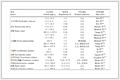
结果 一、术中血流动力学指标比较术后镇痛组在T2时间点HR、MAP出现显著升高(P<0.05),超前镇痛组无明显波动。两组患者在各时间点的SpO2无显著差异(P>0.05)。见表 1。
| 表 1 两组患者不同时间点血流动力学指标的比较(x±s) Table 1 Comparison of hemodynamic indexes between the two groups of patients at different time points(x±s) |
|
术后镇痛组在T5、T6时间点躁动评分较超前镇痛组高,差异具有统计学意义(P<0.05)。见表 2。
| 表 2 两组患者不同时间点躁动评分(分,x±s) Table 2 The agitation scores of the two groups of patients at different time points(point, x±s) |
|
|
术后镇痛组在T8、T9时间点CHEOPS疼痛评分较超前镇痛组高,差异具有统计学意义(P<0.05)。见表 3。
| 表 3 两组患者术后疼痛情况(分,x±s) Table 3 Postoperative pain in the two groups(point, x±s) |
|
|
两组患者不良反应发生率差异无统计学意义(P>0.05)。超前镇痛组出现1例恶心,术后镇痛组出现1例恶心和1例喉痉挛。两组均无一例出现低氧血症。见表 4。
| 表 4 两组患者术后不良反应比较[n(%)] Table 4 Comparison of postoperative adverse reactions between the two groups of patients[n(%)] |
|
|
小儿鼾症手术的围术期麻醉管理要求较高,包括气道和术后疼痛管理等。目前主要采用低温等离子射频消融术进行手术治疗,但术后咽喉部水肿、疼痛等容易引起小儿躁动、上呼吸道梗阻,因此围术期疼痛管理十分重要[7]。另外小儿离开家人陪伴容易产生恐惧感[8]。上述不良反应会对患者造成痛苦和危险,直接影响康复质量,与当今外科快速康复理念不符[9]。超前镇痛是指在伤害性刺激产生前提前给予镇痛措施,阻止或减少外周伤害性电信号向中枢传递,使之下降至中枢敏化阈值以下[10, 11]。超前镇痛能减轻围术期伤害性刺激,减少麻醉药物用量,还能获得良好的苏醒效果和术后镇痛效果[12]。
纳布啡具有阿片类激动- 拮抗混合型镇痛作用,可与μ、κ和δ受体结合,对μ受体呈拮抗作用,对κ受体呈激动作用[13, 14];具有起效快、镇痛作用明确且持续时间长等特点[15]。此外,纳布啡还可减轻炎症反应, 段凤梅[16]通过观察纳布啡超前镇痛对老年开胸手术患者围术期炎性反应的影响,发现纳布啡超前镇痛可以调节免疫平衡,减轻患者围术期炎症反应。据研究报道,纳布啡具有与吗啡相同的镇痛作用,但呼吸抑制作用较轻[17];安全系数高,可缓解轻到中度的疼痛,并产生中等程度的镇静作用,可用于小儿术后静脉镇痛、日间手术、无痛胃镜检查等[18, 19]。
本研究结果显示,两组患者的不良反应发生率均较低,且未出现呼吸抑制、低氧血症等阿片类药物常见的副作用,两组患者的术后镇痛效果良好,表明纳布啡用于小儿鼾症手术的围术期镇痛安全、有效[20]。然而,组间比较结果也显示,超前镇痛组患者在拔管后5 min、10 min两个时间点的躁动评分和CHEOPS疼痛评分均优于术后镇痛组患者,表明纳布啡超前镇痛能获得更优的苏醒质量,可能与纳布啡超前镇痛抑制了伤害性刺激的传入、减少了外周和中枢的痛觉敏化以及减轻了机体炎症反应有关。Yang[21]在小儿开腹手术中使用纳布啡超前镇痛,有效缓解了患者术后疼痛及应激反应。另一方面,本研究中两组患者术后不良反应发生率低,这可能与相对完善的镇痛和平稳的血流动力学状态相关。既往Moyao等[22]研究也发现,将纳布啡与曲马多分别用于小儿术后镇痛的治疗,对比发现虽然曲马多具有显著镇痛效果,但是纳布啡组的不良反应更少。
综上所述,纳布啡超前镇痛用于小儿鼾症手术能有效减轻术后疼痛,减少苏醒期躁动的发生,缩短拔管时间和苏醒时间,且无呼吸抑制等不良反应,是一种安全、有效的围术期镇痛管理方法。
| [1] |
张剑伟, 唐东亮, 徐金. 纤维支气管镜引导下气管插管在小儿鼾症麻醉中的应用[J]. 中国微创外科杂志, 2017, 17(8): 714-716. Zhang JW, Tang DL, Xu J. Application of tracheal intubation guided by fiberoptic bronchoscopy during pediatric snoring disease operation[J]. Chin J Min Inv Surg, 2017, 17(8): 714-716. DOI:10.3969/j.issn.1009-6604.2017.08.012 |
| [2] |
刘学军, 黄赛瑜, 高金建, 等. 鼻内镜下低温等离子射频消融术治疗儿童鼾症的疗效及术后反应观察[J]. 中国内镜杂志, 2016, 22(6): 5-8. Liu XJ, Huang SY, Gao JJ, et al. Effect and postoperative reaction of nasal endoscopic low-temperature plasma radiofrequency ablation on children with snoring[J]. China Journal of Endoscopy, 2016, 22(6): 5-8. DOI:10.3969/j.issn.1007-1989.2016.06.002 |
| [3] |
龙松良, 赵斯君, 黄敏, 等. 鼻内窥镜下低温等离子射频消融术治疗小儿鼾症伴过敏性鼻炎的效果[J]. 中国医药导报, 2019, 16(12): 93-96. Long SL, Zhao SJ, Huang M, et al. Effect of endoscopic low-temperature plasma radiofrequency ablation in the treatment of snoring with allergic rhinitis in children[J]. Chin Med Herald, 2019, 16(12): 93-96. |
| [4] |
何会珍, 魏智慧, 韩田. 氟比洛芬酯超前镇痛在小儿鼾症术中的应用[J]. 实用医学杂志, 2013, 29(14): 2412-2413. He HZ, Wei ZH, Han T. Application of preemptive analgesia with flurbiprofen axetil during pediatric snoring surgery[J]. Journal of Practical Medicine, 2013, 29(14): 2412-2413. DOI:10.396/j.issn.1006-5725.2013.14.074 |
| [5] |
杜真, 张溪英. 小儿围术期舒适化技术的研究进展[J]. 临床小儿外科杂志, 2018, 17(2): 76-80. Du Z, Zhang XY. Research progress of perioperative comfort technology in children[J]. J Clin Ped Sur, 2018, 17(2): 76-80. DOI:10.969/j.issn.1671-6353.2018.02.015 |
| [6] |
GesinG, Kane-Gill SL, Dasta JF, et al. Diazepamasa component of goal-directed sedation in critically illtrauma patients[J]. J Crit Care, 2011, 26(2): 122-126. DOI:10.1016/j.jcrc.2010.09.008 |
| [7] |
吴凡, 梁涛, 丁翠霞. 右美托咪定复合舒芬太尼对小儿鼾症手术全麻苏醒期躁动的影响[J]. 内蒙古医科大学学报, 2017, 39(3): 264-266. Wu F, Liang T, Ding CX. Effect of dexmedetomidine plus sufentanil on restlessness during recovery period of general anesthesia in children with snoring[J]. Journal of Inner Mongolia Medical University, 2017, 39(3): 264-266. DOI:10.16343/j.cnki.issn.2095-512x.2017.03.018 |
| [8] |
潘永英, 陈柳妹, 田航, 等. 右美托咪定对预防七氟醚复合骶管阻滞小儿麻醉苏醒期躁动的作用[J]. 广东医学, 2013, 34(4): 623-625. Pan YY, Chen LM, Tian H, et al. Preventive effects of dexmedetomidine upon agitation during recovery period after compound blockage sevoflurane anesthesia of sacral canal[J]. Guangdong Medical Journal, 2013, 34(4): 623-625. DOI:10.3969/j.issn.1001-9448.2013.04.048 |
| [9] |
赵平, 于威威, 季海音, 等. 右美托咪定滴鼻对小儿苏醒期躁动的预防作用[J]. 中国医师杂志, 2013, 15(7): 895-898. Zhao P, Yu WW, Ji HY, et al. Preventive effects of dexmedetomidine upon agitation during pediatric recovery period[J]. Journal of Chinese Physician, 2013, 15(7): 895-898. DOI:10.3760/cma.j.issn.1008-1372.2013.07.008 |
| [10] |
Bindra TK, Kumar P, Rani P, et al. Preemptive analgesia by intraperitoneal instillation of ropivacaine in laparoscopic cholecystectomy[J]. Anesth Essays Res, 2017, 11(3): 740-744. DOI:10.4103/aer.AER7_17 |
| [11] |
杨昌宇, 胡芳铭, 李汉军, 等. 超前镇痛联合多模式镇痛用于老年髋部骨折手术的效果及对患者炎性因子的影响?[J]. 广东医学, 2016, 37(6): 892-894. Yang CY, Hu FM, Li HJ, et al. Efficacies of preemptive analgesia plus multimodal analgesia for elderly hip fracture operations and effects upon inflammatory factors in patients[J]. Guangdong Medical Journal, 2016, 37(6): 892-894. DOI:10.13820/j.cnki.gdyx.2016.06.026 |
| [12] |
Steinberg AC, Schimpf MO, White AB, et al. Preemptive analgesia for postoperative hysterectomy pain control: systematic review and clinical practice guidelines[J]. Am J Obstet Gynecol, 2017, 217(3): 303-313. DOI:10.1016/j.ajog.2017.03.013 |
| [13] |
刘越, 梁燕冰, 宋兴荣, 等. 纳布啡混合氟比洛芬酯用于妇科腹腔镜术后PCIA的适宜配伍: 多中心、随机、对比研究[J]. 中华麻醉学杂志, 2019, 39(2): 185-188. Liu Y, Liang YB, Song XR, et al. Optimal compatibility of nabufine mixed with flurbiprofen for patient-controlled intravenous analgesia after gynecological laparoscopy: a multicenter, randomized, controlled clinical trial[J]. Chinese Journal of Anesthesiology, 2019, 39(2): 185-188. DOI:10.3760/cma.j.issn.0254-1416.2019.02.015 |
| [14] |
王楠, 董铁立, 付红光. 舒芬太尼复合纳布啡用于剖宫产术后自控静脉镇痛的效果[J]. 临床麻醉学杂志, 2018, 34(5): 449-451. Wang N, Dong TL, Fu HG. Effect of sufentanil plus nalbuphine on patient cintrolled intravenous analgesia after cesarean section[J]. J C Lin Anesthesiol, 2018, 34(5): 449-451. DOI:10.12089/jca.2018.05.008 |
| [15] |
雷超, 廖海燕, 张朝辉, 等. 纳布啡用于术后镇痛有效性与安全性的Meta分析[J]. 中国药房, 2019, 30(4): 101-105. Lei C, Liao HY, Zhang CH, et al. Efficacy and safety of nalbuphine for postoperative analgesia: a Meta-analysis[J]. China Pharmacy, 2019, 30(4): 101-105. DOI:10.6039/j.issn.1001-0408.2019.04.19 |
| [16] |
段凤梅, 孙旭颖, 许乃欣, 等. 纳布啡超前镇痛对老年开胸手术患者围术期炎性细胞因子的影响[J]. 实用医学杂志, 2016, 32(14): 2259-2261. Duan FM, Sun XY, Xu NX, et al. Effects of preemptive analgesia with nalbuphine on inflammatory factors in elderly patients undergoing thoracotomy[J]. Journal of Practical Medicine, 2016, 32(14): 2259-2261. DOI:10.3969/j.issn.1006-5725.2016.14.003 |
| [17] |
杨晴, 马传根, 张义轩, 等. 右美托咪定在纳布啡联合氟比洛芬酯术后PCIA中的镇痛效果[J]. 临床麻醉学杂志, 2018, 34(5): 82-83. Yang Q, Ma CY, Zhang YX, et al. Analgesic outcomes of dexmedetomidine during PCIA of nalbuphine plus flurbiprofen axetil[J]. J Clin Anesthesio, 2018, 34(5): 82-83. DOI:10.12089/jca.2018.05.019 |
| [18] |
Schultz Machata AM, Becke K, Weiss M. Nalbuphine in pediatric anesthesia[J]. Anaesthesist, 2014, 63(2): 135143. DOI:10.1007/s001010142293z |
| [19] |
郭鹏, 王军. 纳布啡的特点及在小儿麻醉中的应用[J]. 国际麻醉学与复苏杂志, 2020, 41(1): 63-66. Guo P, Wang J. Characteristics of nalbuphine and its application in pediatric anesthesia[J]. International Journal of Anesthesiology and Resuscitation, 2020, 41(1): 63-66. DOI:10.3760/cma.j.issn.1673-4378.2020.01.014 |
| [20] |
刘佩珍. 纳布啡在小儿日间手术疼痛护理中的作用[J]. 中国当代医药, 2017, 24(32): 112-114. Liu PZ. Effect of Nalbuphine in pediatric daytime operation pain in nursing[J]. China Modern Medicine, 2017, 24(32): 112-114. DOI:10.3969/j.issn.1674-4721.2017.32.035 |
| [21] |
杨宇, 易庆军, 李秀泽, 等. 纳布啡超前镇痛联合罗哌卡因局部浸润对小儿术后切口疼痛、应激反应及免疫功能的影响[J]. 海南医学院学报, 2017, 23(19): 2690-2693. Yu Y, Yi QJ, Li XZ, et al. Effect of nalbuphine preemptive analgesia combined with ropivacaine local infiltration on postoperative incision pain, stress response and immune function in children[J]. Journal of Hainan Medical University, 2017, 23(19): 2690-2693. DOI:10.13210/j.cnki.jhmu.20170927.003 |
| [22] |
Moyao García D, Hernández Palacios JC, Ramírez Mora JC, et al. A pilot study of nalbuphine versus tramadol administered through continuous intravenous infusion for postoperative pain control in children[J]. Acta Biomed, 2009, 80(2): 124-130. |